
Abyssal Hook
Choose Abyssal Hook when you want a fixed trading fee and want launch income to follow your owner, rewards and burn allocation, without setting aside a share for market making.
It also records a capped price history called a truncated oracle. That record follows market moves gradually; it does not restrict the price at which people trade.
How it works
- You choose the fee and fee denomination before launch. The pool keeps those rules after it opens.
- A trader swaps against the pool's liquidity. The trading fee uses the fixed rate, rather than a rate that changes with market activity.
- Eligible activity updates the price history. The record moves toward the live price by no more than its configured movement cap per block. Several trades in one block do not each get another full movement allowance.
- Earned fees are collected for the launch. Any hook fee first reserves the protocol treasury share. Remaining launch income follows the allocation you chose.
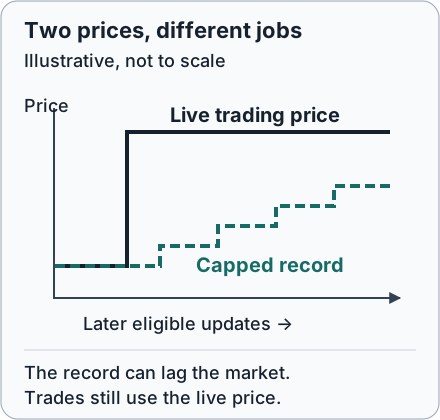
The illustration shows the distinction, not a particular pool's prices or timing. Read truncated oracles for the tradeoff between filtering short spikes and following lasting moves.
Settings in the app
| Setting | Choices and starting value |
|---|---|
| Pool fee | Standard launch tiers: 0.01%, 0.05%, 0.3%, 1%, 2%, 5% or 10%. Starts at 1%. |
| Fee collection | Quote only or Both tokens. The standard launch starts with Quote only. |
| Extra hook settings | None. There is no strategy share or dynamic-fee response to configure. |
With Quote only, the app puts the selected fee in the hook and sets the ordinary LP fee to zero. The quote fee applies on both buys and sells. With Both tokens, this integration uses the selected ordinary LP fee and sets the extra hook fee to zero. Each trade pays in its input asset, so the pool earns quote on buys and launch tokens on sells.
These are the app's standard settings. Integrations using separate LP and hook fees must account for both, rather than treating one as the total.
Who pays and where fees go
The trader pays the trading fee as part of the swap. An ordinary LP fee belongs to the liquidity providers whose positions earned it; only the launch's own LP earnings enter its allocation.
Where the app charges a hook fee, about 20.833% of that hook fee is reserved for the protocol treasury under the current terms. This is a share of the fee, not of the whole trade. The rest goes toward launch income. There is no hook-author royalty and no HMM strategy deduction.
Collection bounties and your owner, rewards and burn split apply to income reaching the launch. See the fee allocation and rounding reference before estimating payouts. Gas is separate.
Limits and risks
A fixed fee is not a fixed execution price. A large trade or thin liquidity can still cause substantial price impact. The oracle can lag real price discovery or reflect a sustained manipulation; it is not an external valuation or a price floor.
Abyssal Hook does not place bids, resell inventory or rebalance the permanently locked launch positions. The app permits outside LPs, who can remove their own positions. Neither the hook nor the lock guarantees that liquidity will remain active near the market price.
When to choose it
Use Abyssal Hook for the simplest fee policy of the four. If you want the fee to rise during rapid upward moves, compare Dynamic Fee Hook. If you want fees to fund a separate inventory strategy, compare Hook Market Maker.
For integration details, see the SDK's pool-bound V4 fee policy reference, or return to the hook comparison.