
Dynamic Fee Hook
Choose Dynamic Fee Hook when you want a lower baseline fee in quiet trading and a higher fee during rapid upward price moves, without funding a market-making strategy.
The fee responds to how quickly the pool's recorded token price rises. Falling or unchanged recorded prices use the base fee. The resulting rate applies to both buys and sells, not only to the trade direction that caused the move.
How it works
- You choose a base fee, a maximum and a response. These settings stay fixed after launch.
- The hook reads its recent truncated price history. It measures the latest recorded upward change against elapsed time. This is the pool's own capped record, not an outside price feed.
- Faster recorded rises increase the fee. Aggressive adds twice as much as Normal for the same signal, until the chosen maximum is reached. Quiet or falling signals, or insufficient history, use the base fee. As the last observation ages, its influence weakens.
- The rate is fixed for that swap before it executes. A trade does not recalculate its fee midway through execution. Its price effect can influence later observations and swaps.
- Fee income follows your launch allocation. There is no HMM strategy share.
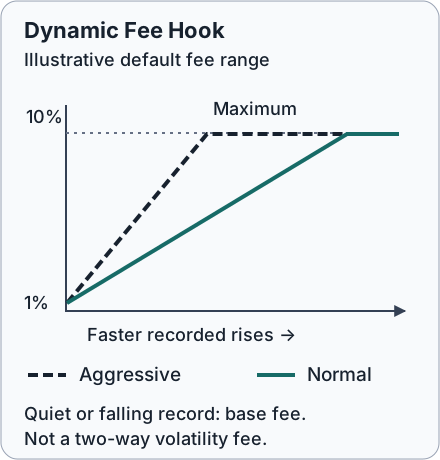
The diagram illustrates the app's 1% base and 10% maximum starting values. It is not a forecast of fees at a particular market return. The signal uses truncated price steps per second, not a percentage move measured over a fixed chart window.
Settings in the app
| Setting | Choices and starting value |
|---|---|
| Base trading fee | Standard tiers: 0.01%, 0.05%, 0.3%, 1%, 2%, 5% or 10%, provided the base is below the maximum. Starts at 1%. |
| Maximum trading fee | 5%, 10% or 15%. Starts at 10%. |
| Fee response | Normal or Aggressive. Starts at Normal. |
| Fee collection | Quote only or Both tokens. The standard launch starts with Quote only. |
The hook charges the trading fee; the ordinary pool LP fee is zero in this integration. Quote only charges the quote asset on buys and sells. Both tokens charges each swap's input asset, so fees can accumulate in both pool tokens across trading, not in both assets on every swap.
Who pays and where fees go
The trader pays the current rate, which can be much higher than the base. About 20.833% of each hook fee is reserved for the protocol treasury under the current terms. The rest reaches the launch's fee allocation, subject to collection bounties. There is no hook-author royalty and no market-making deduction.
For example, a pool configured at a 1% base can charge up to its 10% maximum when the recorded rise is fast enough. Do not estimate a trade using the base alone. Use the current quote, and account separately for price impact and gas.
See the fee allocation and rounding reference for the difference between the fee paid and income available to owners or rewards.
Limits and risks
This is not a general two-way volatility fee. A falling recorded token price does not, by itself, raise this hook's rate. For a two-way response combined with market making, compare Dynamic Hook Market Maker.
The truncated oracle can lag live price moves and can still be affected by sustained manipulation. Higher fees can make a trade more expensive and may discourage trading; they do not guarantee better income or protect the token price.
The hook does not buy tokens, manage inventory or move locked launch liquidity. It does not guarantee a price floor or liquidity near the current price. Outside LPs are permitted and can withdraw their own positions.
When to choose it
Use it if charging more during rapid upward moves matters more than keeping one predictable rate. Choose Abyssal Hook for a fixed fee without a strategy, or Hook Market Maker to fund an inventory strategy with a fixed fee.
For exact fee-policy fields, see the SDK lifecycle reference. Return to the hook comparison to compare all four.