
Dynamic Hook Market Maker
Choose Dynamic Hook Market Maker when you want the HMM inventory strategy and a trading fee that rises during rapid recorded price moves. Unlike the standalone Dynamic Fee Hook, this HMM V2 hook responds to both rises and falls.
It uses a chosen share of fee income for bids below price and resale offers above price. The fixed and dynamic HMM choices use the same strategy mechanics. Their difference is how the trading-fee rate is set.
How it works
- Recent price movement sets the rate. The hook measures the size of the latest change in its truncated price record against elapsed time, whether that change is positive or negative. Faster movement raises the fee from your base toward your maximum. Normal or Aggressive controls the response.
- The rate is fixed before each swap. Both buys and sells pay that rate. Quiet signals, insufficient history or no recorded change use the base. An old observation's influence weakens with elapsed time; the swap does not reprice its own fee midway through execution.
- Each swap reserves strategy funding. The treasury share comes first. Your configured strategy share of the remainder is reserved in each token earned. Quote fees fund bids; launch-token fees join sell-side inventory. With Quote only collection, no launch-token fee is earned.
- Bids acquire tokens below price. The strategy places fee-funded liquidity bands subject to its available funds, maximum bid principal and the pool's oracle reference. Acquired tokens keep their actual purchase cost.
- Resale offers recycle funds. Newly acquired tokens start with a minimum of cost plus the app's 5% premium. That premium decays toward the cost-based minimum over 72 hours for later placements or refreshes. Offers must also respect live price and the oracle reference. Maintenance harvests qualifying fills and reuses proceeds for new bids; it never uses locked launch liquidity.
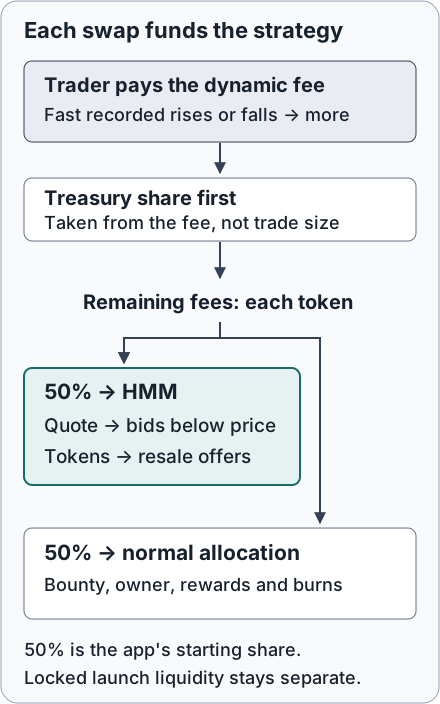
The 50% split is the app's starting choice, not an additional charge to traders. The fixed-fee HMM diagram shows where bids and asks sit on the price axis.
Settings in the app
| Creator choice | Options and starting value |
|---|---|
| Base trading fee | Standard tiers: 0.01%, 0.05%, 0.3%, 1%, 2%, 5% or 10%, strictly below the maximum. Starts at 1%. |
| Maximum trading fee | 5%, 10% or 15%. Starts at 10%. |
| Fee response | Normal or Aggressive. Starts at Normal. Aggressive adds twice as much for the same signal, until the maximum is reached. |
| Fee collection | Quote only or Both tokens. The standard launch starts with Quote only. Both tokens charges each swap's input asset, not both assets on one swap. |
| Liquidity strategy share | 25%, 50% or 100% after treasury, in each fee asset. Starts at 50%. |
The hook charges the trading fee; the ordinary LP fee is zero. With a 1% base and 10% maximum, a fast recorded fall can raise the fee as well as a fast rise. The Normal and Aggressive labels are shared with Dynamic Fee Hook, but the two-way signal is different.
The app supplies the following strategy settings rather than exposing them as extra launch-form controls:
| Strategy setting | App starting value |
|---|---|
| Minimum quote deployment / quote harvest | $1 / $1, converted to quote-token quantities using the launch's configured quote/USD rate. Token harvesting uses a separate budget-based threshold. |
| Maximum bid principal | $100 converted at that rate for a new or refreshed bid, not a lifetime budget. |
| Bid and ask widths | Approximately 3% of price each, rounded to the pool's price grid. |
| Reference deviation | 0. New bids stay at or below the rounded oracle reference; new asks start at or above it, subject also to cost and live-price rules. |
| Resale premium / decay | 5% / 72 hours toward the cost-based minimum. |
Dollar-based defaults become fixed token quantities at preparation, not continuously repriced limits. The reference comes from the pool's own truncated oracle and can lag the live price. Fee-token inventory has no invented acquisition cost. A falling premium changes eligibility for placement or refresh, not a live offer every second; an offer can remain above the cost-based minimum.
Who pays and where fees go
The trader pays the current dynamic hook fee, plus gas. Under the current terms, about 20.833% of each hook fee is reserved for the protocol treasury. On every swap, HMM V2 then reserves your strategy share of what remains, in either pool token earned. Fees are not held until collection before deciding the strategy share.
The unreserved remainder follows your normal owner, rewards and burn allocation, including collection bounties. There is no hook-author royalty. For every 100 units left after treasury, a 25% strategy share reserves 25 and leaves 75 for ordinary allocation; a 100% share leaves none of those hook fees for ordinary payouts. Strategy funds are not also owner income or reward funding.
Swap-triggered maintenance adds gas work for the swap's caller. Anyone triggering separate maintenance pays for that transaction. Use the current swap quote: neither the base fee nor the strategy's resale premium describes a trader's all-in cost. Price impact is separate.
See the fee allocation and rounding reference for the ordinary distribution after the strategy reservation.
What the fee owner can change after launch
The current fee owner can set the strategy share from 0% to 100%, change all strategy settings within contract bounds, and pause placements. The trading-fee base, maximum and sensitivity remain the pool's launch-time policy; strategy controls do not turn them into editable fees.
A new share affects future reservations only. Zero share stops new fee funding, not existing inventory. A strategy update queues a refresh for the next maintenance pass. Pausing removes auxiliary strategy positions during that pass and stops new placements, but does not pause trading, stop fee collection or release locked launch liquidity.
Lowering an inventory cap does not force existing tokens to sell. Existing lots keep their recorded cost floors and ages; a changed purchase premium applies to new acquisitions. These are contract controls and may require direct SDK/contract use, rather than an app form. See the HMM V2 owner-control reference.
Limits and risks
A higher fee during a sharp fall can make selling more expensive. It does not halt that fall or guarantee enough future fee income to replenish bids. The strategy has finite funds, and its bids can be exhausted. Tokens acquired by bids can lose value or remain unsold.
There is no price floor or profit guarantee. Resale rules constrain the strategy's offers, not market prices; premium decay does not guarantee a fill after 72 hours or returns after fees and gas. The truncated oracle can lag or be manipulated. Thresholds, inventory limits, pauses or failed maintenance can leave funds idle, and the fee owner can later change the strategy materially.
HMM does not rebalance locked launch liquidity, burn its inventory or lend it out. Outside LPs are permitted and can remove their own positions.
When to choose it
Choose it if you want fee-funded inventory management and accept both variable trader costs and less immediately distributable fee income. Use Hook Market Maker for the same strategy with a fixed fee. Use Dynamic Fee Hook for an upward-only fee response without inventory management.
This page describes HMM V2, selected by SDK 0.10.0, not an upgrade to earlier HMM launches. Use the HMM V2 SDK reference for the exact contract interfaces and bounds, or return to the hook comparison.